English
 العربية
 Nederlands
 Français
 Deutsch
 Italiano
 Português
 Русский
 Español
 Polski
 한국어
 Türkçe
 हिन्दी
 ไทย
 日本語
Thermoplastic polyurethane (TPU) is a versatile polymer that combines rubber-like elasticity with the processing advantages of thermoplastics. Known for its abrasion resistance, flexibility, mechanical strength, and oil resistance, TPU is widely used in footwear, wires and cables, automotive components, electronics, tubing, and films.
However, different applications require different material properties. For example, wire and cable applications may require improved flame retardancy, electronic components may need antistatic properties, and industrial parts may demand greater stiffness, strength, or dimensional stability.
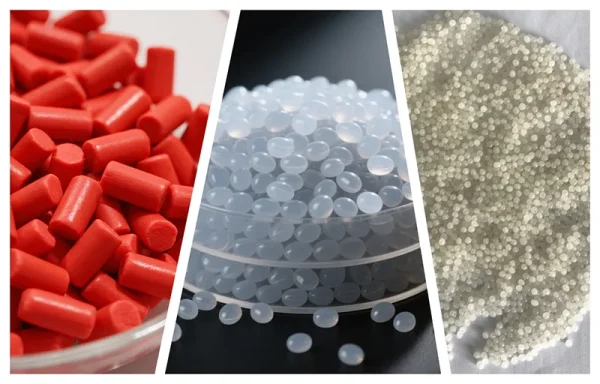
TPU compounding allows manufacturers to modify these properties by incorporating flame retardants, fillers, reinforcing materials, stabilizers, and other functional additives into a TPU base material.
This article explores the main types of TPU compounding equipment, typical production processes, and the customized TPU compounding solutions offered by Beyou.
1. What Is TPU Compounding?
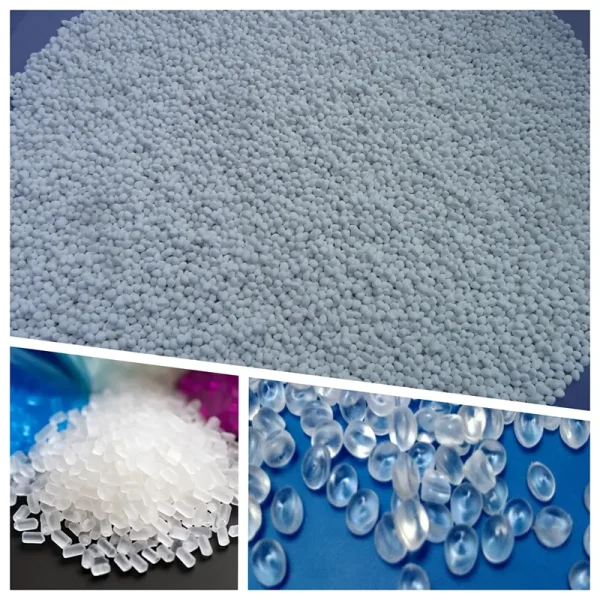
TPU compounding is the process of melt-mixing TPU resin with flame retardants, fillers, reinforcing materials, colorants, or other functional additives according to a specific formulation to produce TPU compounds with targeted properties.
The process typically uses equipment such as twin-screw extruders to mix and disperse the ingredients. The compounded material is then cooled and pelletized for downstream processes such as injection molding and extrusion.


Common Types of TPU Compounding
Common TPU modification methods include:
- Flame-Retardant Compounding: Incorporating flame retardants and synergistic additives to improve flame resistance for applications such as wires, cables, and electrical components.
- Filler Compounding: Adding inorganic fillers, such as calcium carbonate or mica, to adjust stiffness, dimensional stability, or formulation costs.
- Color Compounding: Incorporating pigments, color masterbatches, or other colorants to achieve the desired color and uniform dispersion.
- Functional Compounding: Adding antistatic agents, conductive fillers, hydrolysis stabilizers, or UV stabilizers to improve performance under specific operating conditions.
- Polymer Blending: Melt-blending TPU with other polymers to modify processing characteristics or overall properties. Polymer compatibility must be considered when developing the formulation.
Each modification method has different requirements for mixing, dispersion, shear intensity, fiber length retention, and processing temperature. Therefore, selecting suitable TPU compounding equipment is essential.
2. Types of TPU Compounding Equipment
TPU compounding equipment varies depending on the formulation, reinforcing materials, and desired product properties. Twin-screw compounding lines are commonly used for conventional TPU modification, while long-fiber impregnation extrusion lines are designed to produce long-fiber reinforced TPU compounds.
① TPU Twin-Screw Compounding Line
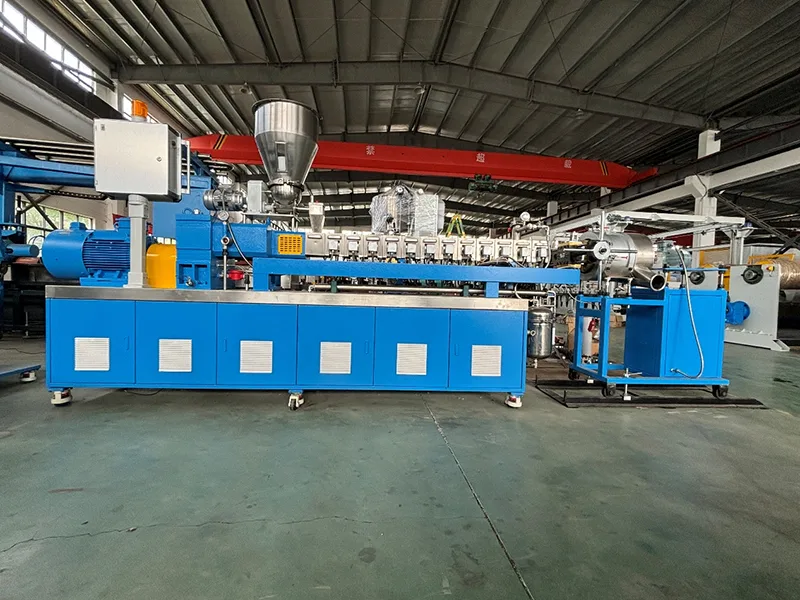
A co-rotating twin-screw extruder is one of the most widely used machines for TPU compounding. Its modular screw design allows manufacturers to adjust melting, mixing, and dispersion conditions for different formulations, making it suitable for multi-component TPU compounds that require controlled feeding and consistent mixing.
Typical applications include:
- Flame-Retardant TPU
- Filled TPU
- Colored TPU
- Functional TPU
- TPU Polymer Blends
- Short-Fiber Reinforced TPU
Depending on the formulation and production requirements, a complete TPU twin-screw compounding line may include the following auxiliary systems:
Equipment System | Main Function |
|---|---|
Material Drying System | Removes moisture from TPU resin to reduce the risk of hydrolytic degradation during melt processing. |
Metering and Feeding System | Controls the feeding rates and proportions of TPU resin, fillers, and additives. |
Side Feeding System | Introduces glass fibers, fillers, or other components at suitable positions along the extruder barrel. |
Liquid Dosing System | Accurately meters liquid additives or other liquid ingredients into the process. |
Vacuum Venting System | Removes entrained gases and volatile components from the melt. |
Cooling and Pelletizing System | Cools the extruded TPU melt and converts it into pellets of the required size. |
The specific equipment configuration should be determined based on the TPU grade, formulation, target output, and pelletizing requirements.
② TPU Long-Fiber Impregnation Extrusion Line
A TPU long-fiber impregnation extrusion line is used to produce TPU compounds reinforced with long glass fibers or carbon fibers.
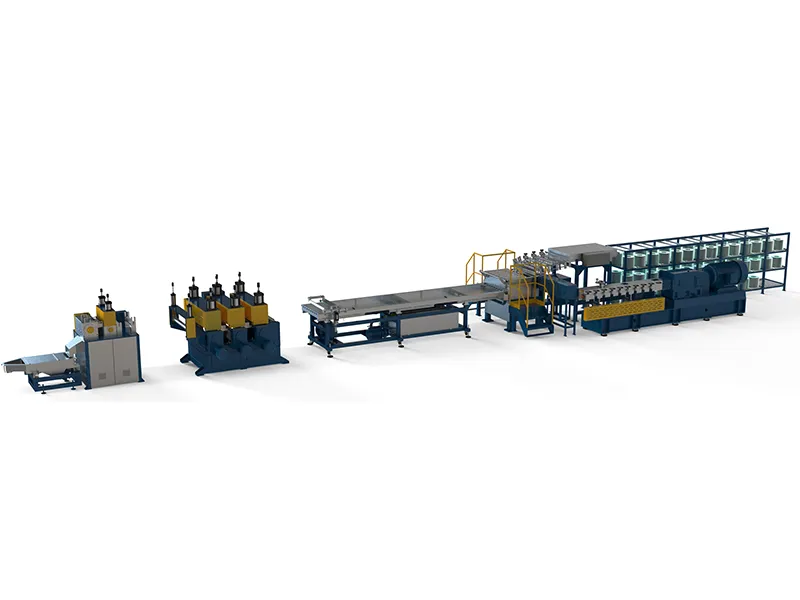
Unlike conventional twin-screw compounding with short fibers, Continuous glass or carbon fiber bundles are guided through a controlled impregnation system, where the fiber bundles are spread and impregnated with TPU melt. The process aims to achieve thorough resin penetration into the fiber bundles while maintaining fiber continuity and length. It aims to achieve thorough resin impregnation while retaining longer fiber lengths.
This method can be used to develop reinforced TPU materials requiring greater stiffness, strength, or dimensional stability. The final properties depend on the fiber type, fiber content, impregnation quality, and subsequent molding conditions.
A typical production line consists of:
- Fiber Creel and Tension Control System: Continuously supplies glass or carbon fibers while maintaining stable fiber tension.
- Fiber Preheating and Spreading System: Preheats and spreads the fiber bundles when required to improve impregnation conditions.
- Melt Extrusion and Impregnation System: Delivers TPU melt to the impregnation die, allowing the polymer to penetrate the continuous fiber bundles.
- Cooling System: Cools the impregnated composite strands.
- Pulling System: Controls the continuous movement and pulling speed of the fiber-reinforced strands.
- Pelletizing System: Cuts the cooled composite strands into reinforced pellets of the required length.
Compared with conventional TPU twin-screw compounding, long-fiber impregnation places greater emphasis on fiber tension control, melt impregnation quality, and fiber length retention.
3. TPU Compounding Process
The TPU compounding process depends on the formulation and desired material properties. Conventional TPU compounds are typically produced using co-rotating twin-screw extrusion, while long-fiber reinforced TPU requires a continuous fiber impregnation process to minimize fiber breakage.
① Twin-Screw TPU Compounding Process
A typical twin-screw TPU compounding process follows these steps:
Material Preparation and Drying → Formulation and Metered Feeding → Melting and Plasticization → Mixing and Dispersion (with Side Feeding or Liquid Dosing as Required) → Venting → Extrusion → Cooling and Pelletizing
Process Step | Description |
|---|---|
Material Preparation and Drying | TPU resin is thoroughly dried to reduce the risk of hydrolytic degradation and processing defects caused by moisture. |
Formulation and Metered Feeding | TPU resin and additives are fed into the extruder at controlled rates according to the formulation. |
Melting and Plasticization | TPU melts under barrel heating and mechanical action from the screws, forming a melt suitable for compounding. |
Mixing and Dispersion | Screw elements distribute and disperse the ingredients. Certain fillers, fibers, or liquid additives may be introduced at appropriate positions depending on the formulation. |
Venting | Entrained gases and volatile components are removed when required by the process. |
Extrusion | The compounded TPU melt passes through the extrusion die. |
Cooling and Pelletizing | The extrudate is cooled and pelletized using a method suitable for the material properties and production requirements. |
Key process control factors include:
- Temperature Control: Barrel temperatures should be adjusted according to the TPU grade and formulation to prevent insufficient melting or thermal degradation.
- Screw Speed and Feeding Rate: Proper control of shear intensity and residence time helps balance mixing performance with material stability.
- Feeding and Venting: Additive feeding positions and venting conditions should be optimized according to the material characteristics and formulation.
TPU generally requires thorough drying before melt processing. Vacuum venting cannot replace proper material drying. Specific processing temperatures, moisture limits, and operating conditions should follow the TPU supplier's recommendations.
② Long-Fiber Reinforced TPU Compounding Process
Unlike conventional twin-screw compounding, long-fiber reinforced TPU typically uses a continuous fiber impregnation process to reduce fiber breakage during processing.
A typical process follows:
Fiber Unwinding and Tension Control → Fiber Preheating and Spreading → TPU Melt Impregnation → Cooling → Pulling → Pelletizing
During production, continuous glass or carbon fiber bundles are fed into the impregnation system under controlled tension. TPU melt supplied by an extruder penetrates the fiber bundles, which are then cooled, pulled, and cut into long-fiber reinforced TPU pellets.
The key process requirements are melt impregnation quality, fiber tension control, and fiber length retention. Compared with short-fiber compounding, continuous impregnation helps preserve longer fibers and provides the potential to improve stiffness, strength, and other mechanical properties. Actual performance depends on the formulation and subsequent molding conditions.
4. Beyou TPU Compounding Solutions
Beyou offers customized TPU compounding solutions, including twin-screw compounding lines and pelletizing lines, with equipment configurations tailored to different TPU formulations and production requirements.
① Customized Process and Screw Configuration
Beyou customizes extruder specifications, screw configurations, and processing conditions based on TPU grade, hardness, melt flow characteristics, filler content, and target output to achieve stable and efficient compounding.
② Flexible Feeding and Venting Systems
Depending on the formulation, Beyou can integrate loss-in-weight feeders, side feeders, liquid dosing systems, and vacuum venting units to support accurate material feeding, effective mixing, and stable processing.
③ Process Testing and Technical Support
Beyou provides material trials, equipment selection, process optimization, installation, commissioning, and after-sales support to help customers establish reliable TPU compounding operations.
Looking for a TPU Compounding Solution?
Contact Beyou with your TPU formulation, target capacity, and application requirements for a customized equipment solution.